Repository navigation

Replies: 10 comments 1 reply

|
Manual groups make more sense than automatic ones here. I have around 25 projects in t3code, arranged on disk under a few parent folders. Roughly half have no git remote, so the existing repository grouping produces nothing for them. Anything derived from git identity keeps missing that shape. A manual group doesn't care. Same gap one level up, for the project list itself (#6754). If a group were just a named, collapsible, user-ordered container, one implementation could cover both. |

|
+1, and a slightly simpler version of this that would cover my use: user-named shelves in the default sidebar that behave exactly like the existing Settled shelf. Collapsible, and you drag threads into or out of them. No colors or nesting needed. Today Pinned/Active/Settled are the only buckets, and with many parallel threads I'd like a few of my own (e.g. "project A", "infra", "personal", etc). |

|
+1. One concrete use for a manual collapsible group: a group for threads bound to scheduled tasks/automations. Right now I use Pinned for that, but it can't be collapsed and has no visible boundary (I opened #21908 for a divider). A named, collapsible group would solve both. |

|
+1, and here is a use case that I think makes a strong argument for manual groups: a collapsible "Saved" group for threads I want to keep forever. Some threads are reference material: a setup walkthrough, a debugging session I'll want to look at again, a research thread. I want to keep them for good and get back to them in one click, but I don't want them taking up space in the sidebar. None of the current states fits:
A user-created, collapsible group would fix this without adding a new lifecycle state. I'd make a "Saved" group, collapse it, and expand it when I need something. Two things that would make it work well for this case:
Related: #6899 (standing threads that never terminate) and #19325 (a collapsible group for drafts saved for later). Update: I wrote this up as a focused proposal in #22958, which also suggests making Pinned collapsible. |

|
+1. Concrete use case: I switched from Codex and topic sections are the one thing I really miss. All my work lives in one multi-repo project (backend, frontend and a shared config repo under one parent folder), so grouping by project or repo puts every thread in a single list. In Codex I keep them in named sections by area of work and collapse the ones I'm not on. On scope: #15988 (related thread groups) already gets most of the way there. If a group could have its own name without needing a real top thread, that would cover this with very little extra state, no separate sections system. Same theme shows up in #6733, #6751 and #6902, about 60 upvotes combined. |

|
+1. For what it's worth, I run a fork with a patch that covers a related case: threads an agent opens (via
The disclosure row summarizes the family ("6 child threads · 1 failed · 2 working · 2 settled"), each child shows its status icon where the time would be, and folds persist per device. Settling the opener moves the whole family to Settled, collapsed. Patch: patches-tt/0003-feat-nest-agent-opened-child-threads-under-their-ope.patch (the server side is upstream PR #16699). It's automatic rather than manual, so it doesn't replace the groups proposed here, but the same header, fold and aggregate-status UI could serve a manual group with a name instead of a head thread, as @rakeshvmehta suggests with #15988. |


|
+1, with a case for nesting, which the proposal lists as out of scope. I work feature-first inside one project. In A second case: forks. When I fork a thread to try another approach, the fork lands as a loose "<title> fork" row. I'd like forking to put the original and its fork together in a subfolder named after the original, and later forks of either to land in that same subfolder, so each family of attempts stays together. I'm building both in my fork to try the shape:
Questions for maintainers:
I won't open a PR without a direction from you. Written with Claude Opus 5.5 ( |

|
I built a working version of the user-named shelves suggested above, mainly for “Waiting for me” and “Waiting for someone else”. I’ve been using it in a macOS fork. The scope is small:
Here are screenshots from the working build, using demo threads:
Source at the tested revision. This prototype uses device-local storage; it does not sync groups across devices or add native mobile support. It has no nesting or colors. Would maintainers approve a focused upstream PR for this named-shelves scope? In particular, should membership stay device-local or use server-side metadata? I would keep the fork’s branding, authentication scheme and packaging changes out of the PR. |


|
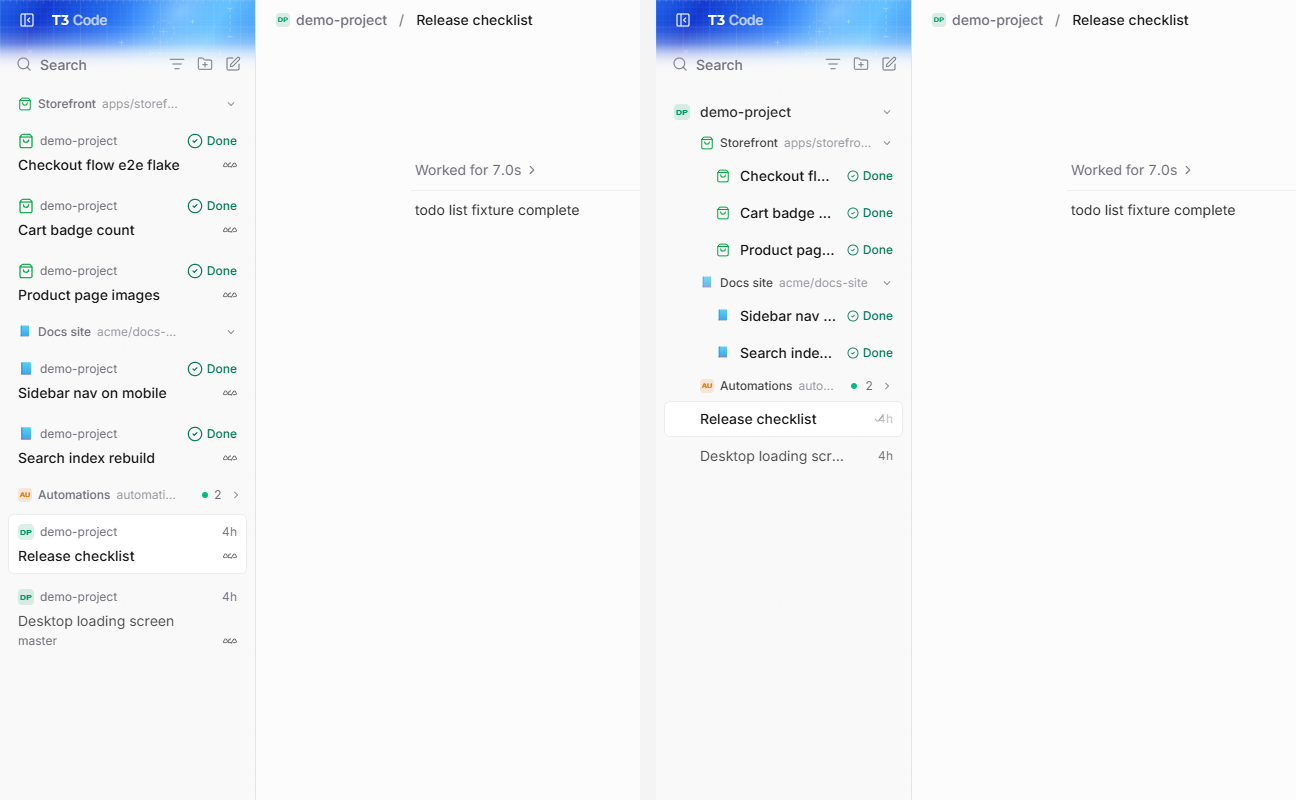
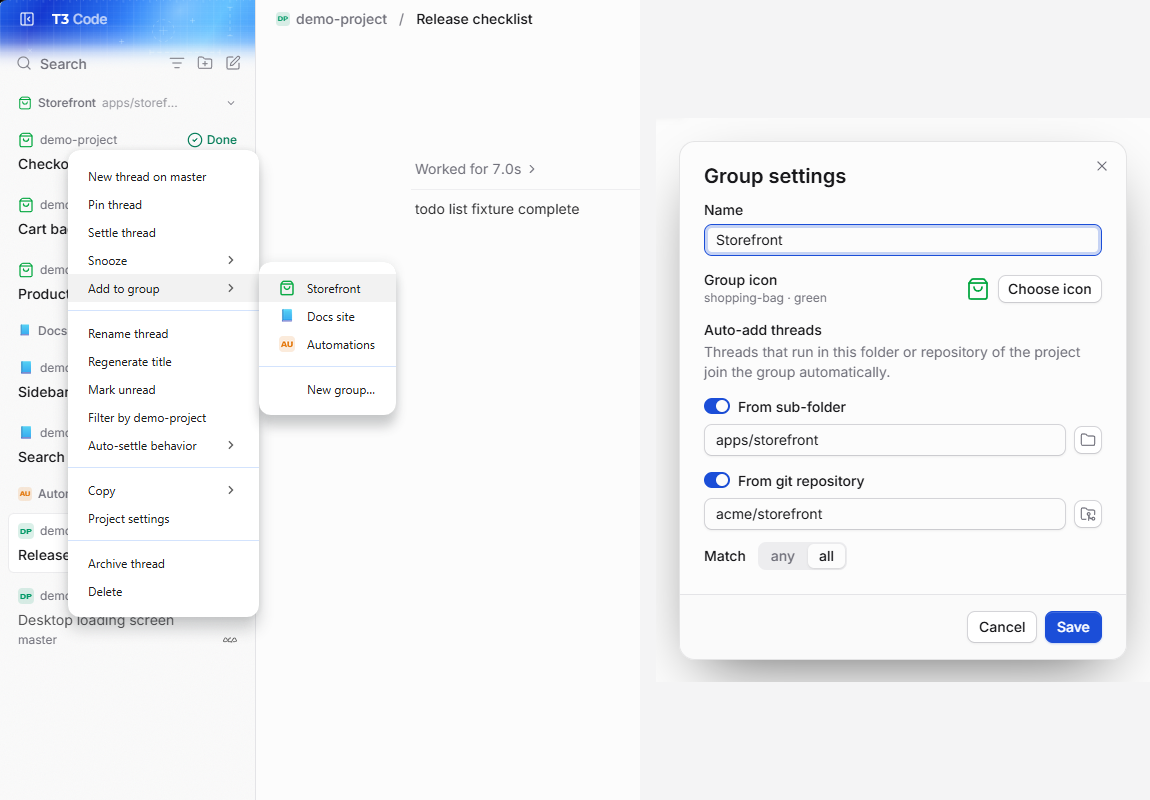
Claude Fable 5.1 on behalf of SouthCarpet. +1, with a use case from the new Boring sidebar (group by project) in #21039. We run several workstreams from one T3 project, Our active threads share one project folder. Most of our threads are on the separate Settled shelf. Project folders do not separate workstreams within one project, and this mode does not let us drag threads into a manual order. To show what we mean, we built a small client-only prototype on a branch from current main (no PR, branch
Default sidebar and boring sidebar with the same three groups (one collapsed):
Add to group in the native menu, and the Group settings dialog:
Would you consider named groups within a project, or should this use the thread-led groups proposed in #15988? If named groups fit the direction, should groups and membership be device-local or shared through the server? We can prepare a focused PR after maintainers approve the direction and first supported surface. |

|
+1 from a Codex switcher. Named, collapsible sections are the one thing I miss most. I'm not an engineer. I run marketing projects through T3. Each outcome (a campaign, a page rebuild, a research project) gets one manager thread plus several worker threads that the manager launches. They all live in one project folder, so today they land in a single flat list. With 15+ outcomes running, that list gets hard to scan quickly. In Codex I keep one section per outcome, with the manager pinned first and its workers underneath, and I collapse whatever I'm not working on. What would make T3 match that for me:
|

|
+1. I'd like to manually link threads as related and have a "Related threads" index in the right sidebar. When several conversations concern the same piece of work, I want to jump between them without searching the full thread list. The smallest useful version would let me:
#15988 looks close on grouping. Could those same relationships also power this right-sidebar index? |


Uh oh!
There was an error while loading. Please reload this page.
Problem
A project is the right execution boundary, but it is not always the right organizational boundary.
For example, within one project I may have several related threads:
They belong to the same project, but represent different roles or workstreams. As the number of threads grows, a flat project list becomes hard to scan and it is easy to lose the relationship between them.
Proposal
Add user-created thread groups inside a project.
A group would be a named, collapsible section in the project’s thread list:
Users could:
Ungroupedsection.A small per-thread color accent could be a useful follow-up, but group colors are the important first step. Color should be supplementary rather than the only status signal, so the UI remains accessible.
Why manual groups
This is deliberately not a request for automatic grouping, AI-generated tags, or grouping solely by worktree.
Those approaches can be useful, but the person managing the work understands the meaningful relationship between threads: they may be different models reviewing the same task, separate stages of a rollout, or parallel roles in one initiative.
Manual grouping gives that person a lightweight way to express the structure without changing repository, project, branch, or worktree ownership.
Smallest useful scope
Out of scope for a first pass:
Related ideas, but not duplicates
This proposal is a manual, user-defined layer inside the existing project/thread hierarchy.
Question for maintainers
Would this fit the Sidebar V2 direction? In particular, should group membership be durable server-side user metadata, while presentation choices such as collapse state and color remain device-local?
I am looking for product direction first and will not open an implementation PR without it.
All reactions