




Unified AI assistant configuration management.
Built in Python, consumable from both Python and Node.js projects.
Currently, AICfg has only one command: link.
One source of truth per assistant. Pick any as your source.
AI coding assistants each have their own config files — instructions, skills, rules, agents. Managing them across multiple tools means editing the same content in multiple places. aicfg link solves this by creating symlinks so all assistants point to a single source.
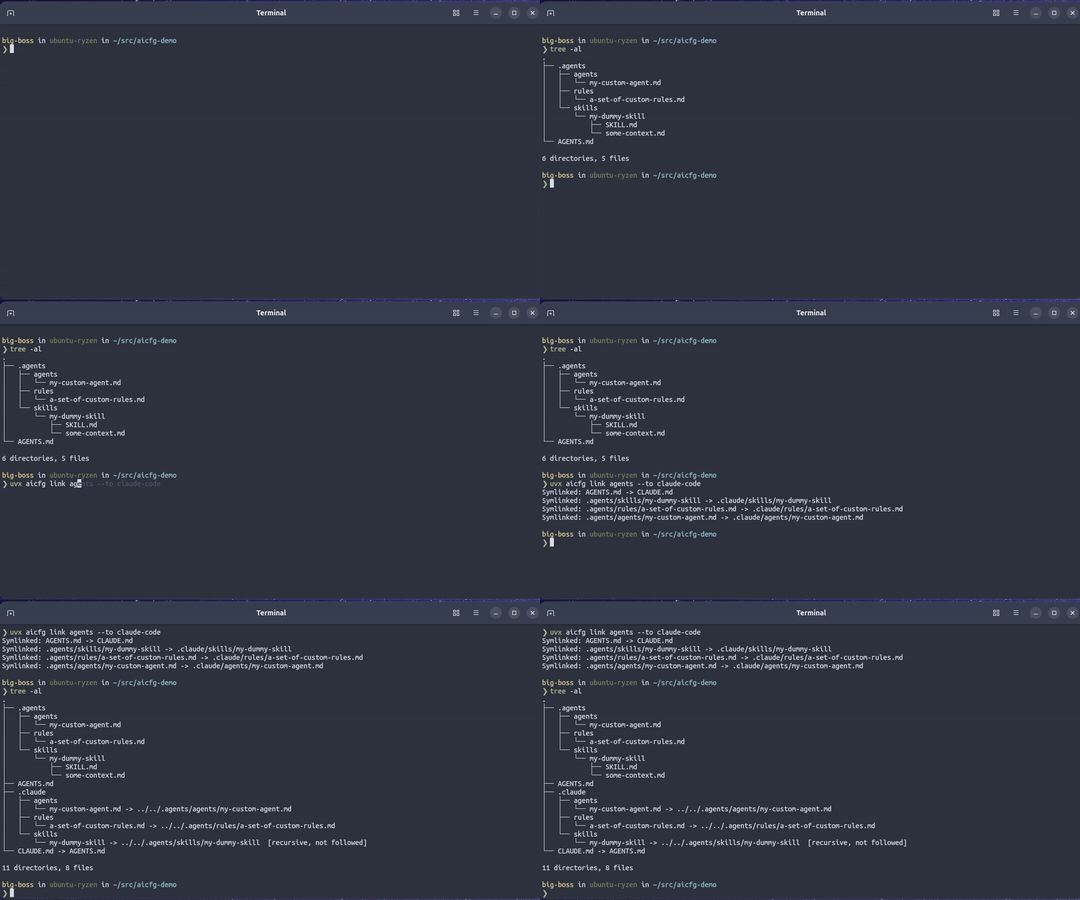
Note: you can pick any of the supported assistants as a source or a target.
| Name | Instructions | Skills | Rules | Agents |
|---|---|---|---|---|
| claude-code | CLAUDE.md |
.claude/skills/ |
.claude/rules/ |
.claude/agents/ |
| cursor | .cursorrules |
.cursor/skills/ |
.cursor/rules/ |
.cursor/agents/ |
| github-copilot | .github/copilot-instructions.md |
.github/skills/ |
.github/instructions/ |
.github/agents/ |
| agents | AGENTS.md |
.agents/skills/ |
.agents/rules/ |
.agents/agents/ |
| opencode | AGENTS.md |
.opencode/skills/ |
.opencode/rules/ |
.opencode/agents/ |
# Dry run — see what would happen without creating symlinks
uvx aicfg link github-copilot --to claude-code,cursor --dry-run

# Link github-copilot → claude-code and cursor
uvx aicfg link github-copilot --to claude-code,cursor

# Link to all assistants at once
uvx aicfg link agents --to claude-code,cursor,github-copilot,opencode

# Verbose output
uvx aicfg link cursor --to claude-code --verbose
Python projects — skip uvx: add aicfg to your project and run uv instead of uvx to reuse your existing environment:
uv add --dev aicfg
uv run aicfg link cursor --to claude-code
npm users — install Python 3.11+ first, then replace uvx with npx, or install globally with npm install -g aicfg.
Install with pip
# Install with pip
pip install aicfg

# Run installed
aicfg link agents --to claude-code
Add this to your .pre-commit-config.yaml:
- repo: https://github.com/TomerFi/aicfg
  rev: "0.2.0"
  hooks:
    - id: link
      args: ["cursor", "--to", "claude-code", "opencode"]
Choose a source from the table above as the first arg and your targets via --to.
Add this to a GitHub Action to fail if symlinks drift:
- name: Ensure assistant files are linked
  uses: tomerfi/aicfg/link@0.2.0
  with:
    source: agents
    target: claude-code,opencode
verbose: trueaicfg link creates relative symlinks between assistants. For instructions, a file symlink is created at the target path pointing back to the source. For directory categories (skills, rules, agents), the target directory is created and each direct entry inside it is symlinked.
For directories, each entry (file or subdirectory) is symlinked as-is into the target directory. Files become file symlinks, directories become directory symlinks — the entries themselves are symlinked, not their individual contents. The source file acts as the single source of truth — edit it once and all targets receive your changes immediately.
Symlinks cloned as regular files — if your git checkout has symlinks as regular files instead of → links, your git config has core.symlinks=false. Fix it with:
git config core.symlinks true
git checkout -- <path>        # e.g. .claude/ .agents/
For future clones, run git config --global core.symlinks true beforehand. This is the default behavior for most modern git clients.