
Every second counts. You have a choice. They don't.
Go Vegan is a free, open-source educational call to action about animal use, the lives affected by it, and the choices people can make when animal use is unnecessary.
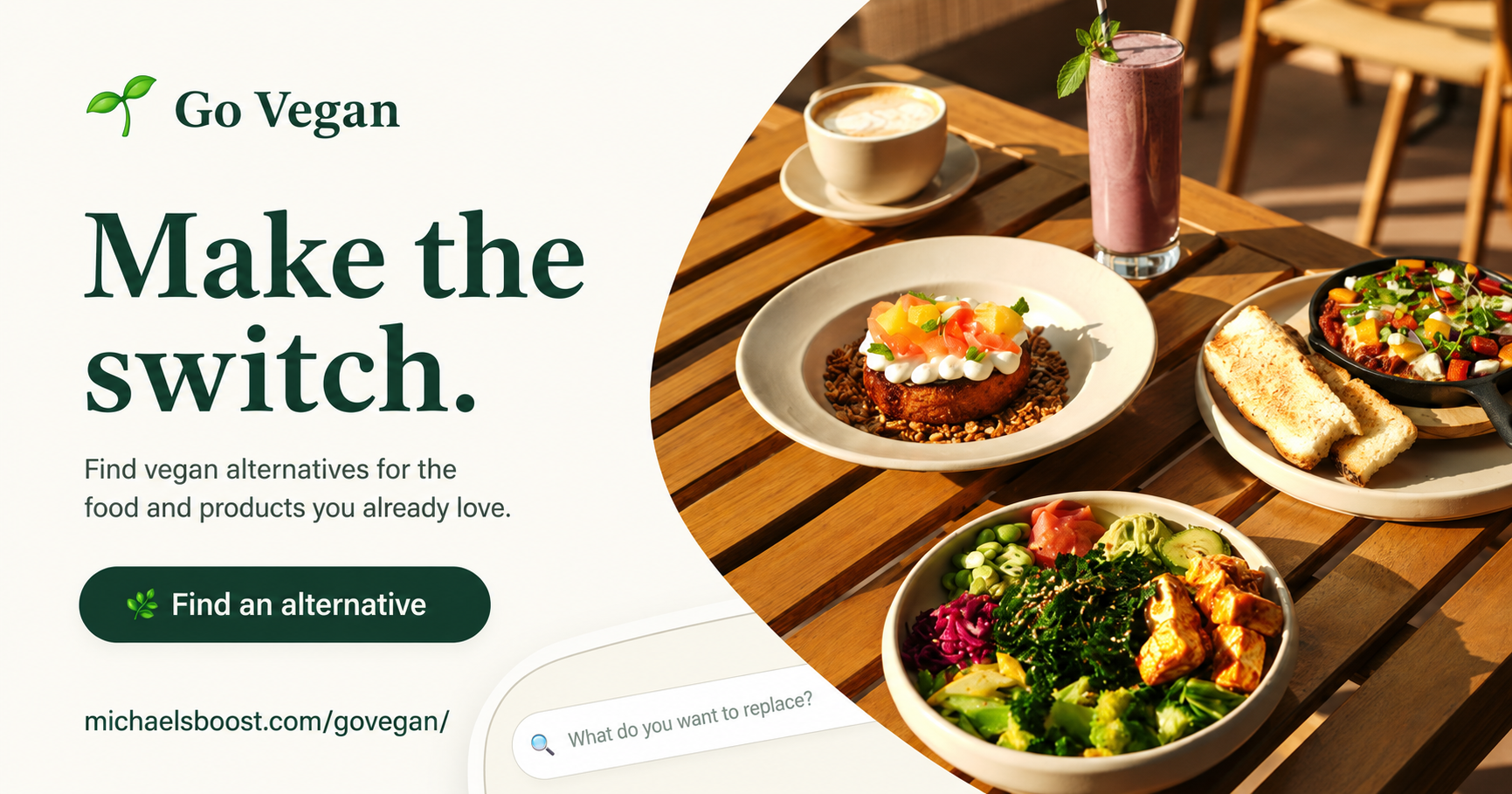


Go Vegan is designed to connect information with action. The project asks a simple question:
If you don't need to use animals, why do it at all?
The app brings together information about animals, animal use, ingredients, nutrition, environmental impact, common arguments about veganism, educational films, outside resources, and practical next steps.
The goal is not to hide the consequences of animal use behind products, industries, or familiar habits. Go Vegan makes those connections visible, provides sources where factual claims can be checked, and gives people places to continue learning and take action.
No account is required. The project is free, open source, client-side, and designed for desktop and mobile use.
Version 2.3.0 expands the official Go Vegan research downloads with two source-linked government-records reference libraries, each offered as both a ready-to-share PDF and an editable Word document.
- Added Slaughterhouse Violations & Government Records, covering USDA humane-handling enforcement, poultry rules, workplace-safety records, environmental compliance, and methods for checking individual facilities.
- Added Government-Funded Hunting & Animal Exploitation, covering public game-bird releases, recreational fish stocking, wildlife-damage management, and relevant government funding records.
- Added both documents to the homepage's official downloads and the Resources section, with PDF and DOCX download options.
- Updated the bundled kodeWeave project to include the same download controls and layout; its document links resolve against the live website once the new files are deployed.
- Preserved the documentary carousel, locally bundled artwork, lightbox, existing research documents, and previous release history.
- Updated version metadata and the service-worker cache for 2.3.0.
New files:
docs/slaughterhouse-violations-government-evidence-library.pdfdocs/slaughterhouse-violations-government-evidence-library.docxdocs/government-funded-hunting-and-stocking-programs.pdfdocs/government-funded-hunting-and-stocking-programs.docx
The libraries describe public records and documented agency actions; they should not be read as proof that every facility or every hunted animal falls under the same circumstances. See each document's source notes and caveats.
Version 2.2.0 expands the educational viewing experience and makes official outreach and research materials easier to find.
- Reorganized the homepage's Essential Viewing carousel into a progression from introductory videos, through industry documentaries and research, to farm-transition stories and programs.
- Expanded the viewing selection with films addressing dairy, fashion, nutrition research, marine captivity, environmental impacts, and industrial farming.
- Added video entries for Rowdy Girl Sanctuary, the Rancher Advocacy Program, The Transfarmation Project, and Refarm'd.
- Plays supported embedded videos in the homepage lightbox; the 12-minute film, Gary Yourofsky speech, and Dominion retain external viewing links. Third-party embedding depends on the video host's permissions.
- Added local documentary poster imagery with a centered, fully visible poster and a blurred backdrop.
- Added Compact, Comfortable, and Large resource-card display preferences. Large is the default for new visitors; the preference is remembered locally.
- Prioritized Official Go Vegan Resources above the resource catalog in a compact, collapsed download panel.
- Made the Scientific Evidence Library, Veganism Debate Master Sheet, Critical-Thinking Terminology Reference, and printable portrait/landscape outreach cards available from the site; key PDFs and cards are also accessible from the homepage.
- Updated release metadata and the service-worker cache identifier to 2.2.0.
Release history is maintained here in the README. For deployment, upload the website files to your static host, verify the homepage video lightbox and external playback exceptions, test the official PDF downloads, and confirm the Resources display preferences on mobile and desktop.
Version 2.1.0 is an evidence and outreach release focused on making Go Vegan easier to use in live conversations and easier to verify afterward.
- Added the finalized one-page Veganism Live Debate Master Sheet, designed as a fast printable reference for live discussions.
- Rebuilt the Scientific Evidence Library into a deep research companion covering veganism, animal sentience and welfare, nutrition and health, agriculture, ecology, climate and land use, fishing and aquaculture, public health, food systems, economics, social impacts, companion animals, and farmer transition.
- Evidence sections now lead with plain-English explanations before deeper scientific detail so readers do not need prior subject knowledge.
- Scientific and technical abbreviations are expanded on first use rather than assuming the reader already knows them.
- Source citations sit directly with the claims they support.
- URLs in the Scientific Evidence Library are clickable, including the Go Vegan footer link on every page.
- The Scientific Evidence Library includes the Go Vegan QR code and consistent footer on every page.
- Fish sentience, emotion, cognition, and pain coverage was strengthened and clarified using peer-reviewed evidence.
- Evidence wording was audited to distinguish strong findings, limitations, observational evidence, modeled estimates, official primary sources, and ethical reasoning.
- Soy allocation, crop-death claims, environmental metrics, companion-animal nutrition, pregnancy, childhood nutrition, and other commonly disputed topics were revised to avoid overstatement.
- Project documentation and release metadata are synchronized for version 2.1.0.
Version 2.0.0 is a major redesign of Go Vegan around a clearer call to action and a more focused educational experience.
- A completely redesigned homepage opens with Every Second Counts, You Have a Choice. They Don't., and If you don't need to use animals, why do it at all?
- A live counter translates the scale of animal killing into something visitors can see changing while they are on the page.
- The homepage now connects the ethical question directly to evidence, animal stories, practical action, and educational films.
- A film experience places 3 Minute Movie first and includes major educational speeches and documentaries, with external viewing used when a provider does not allow reliable embedded playback.
- The Resources section has been reorganized and expanded with visual previews for films, documentaries, talks, guides, and other educational material.
- The Impact experience presents global land-animal slaughter data, U.S. context, environmental comparisons, methodology, sources, and interactive time horizons.
- The Animals Library remains a central part of the project, connecting natural lives with human uses, documented practices, derived ingredients, everyday items, alternatives, and sources.
- The Evidence Library provides source-backed responses to common questions, objections, and claims surrounding veganism.
- When Harm Becomes Normal examines how harmful practices can become socially accepted through repetition, tradition, law, language, institutions, and distance from their consequences.
- The Ingredient Library and Ingredient Checker help identify animal-derived and source-dependent ingredients.
- Nutrition education highlights nutrients commonly considered when eating vegan.
- Practical food help now points visitors to a larger external vegan recipe collection rather than maintaining a limited built-in recipe catalog. This gives users access to a broader selection of budget-conscious meals and cooking ideas that can continue to grow independently of the app.
- The interface has been refined across desktop and mobile, including full-screen editorial sections, navigation, film previews, responsive layouts, and accessibility behavior.
- Go Vegan has a new visual identity designed to represent urgency and animal liberation rather than generic plant-based branding.
- A self-contained kodeWeave project is included for testing and sharing the application in a CodePen-style HTML/CSS/JavaScript environment.
- Project metadata and release files have been synchronized for version 2.0.0.
The homepage is intentionally different from a conventional product landing page. It is structured as a progression from awareness to action.
It begins with the choice at the center of the project, shows the scale of animal deaths occurring over time, challenges common justifications, asks visitors to consider the animal's perspective, and then provides ways to learn and act.
Educational films are available directly from the homepage so a visitor does not need to understand the rest of the application before encountering the issue itself.
The homepage also connects visitors to practical help, including outside recipe resources, vegan support programs, nutrition information, animal profiles, evidence, and other educational material.
The Animals Library introduces animals used for food, clothing, materials, research, entertainment, labor, companionship, trade, and other human purposes.
Profiles can include:
- natural habitat, diet, behavior, communication, parenting, cognition, and lifespan
- industries and human uses
- documented physical practices
- welfare concerns
- animal-derived ingredients
- everyday products associated with the animal
- vegan alternatives
- supporting sources
The purpose is to reconnect products and practices with the living beings affected by them. Sensitive subjects are presented for education and documentation, not as entertainment.
The Impact section makes large-scale consequences easier to understand while keeping methodology and uncertainty visible.
The app presents the latest global land-animal slaughter data available from its cited datasets and translates annual totals into daily, hourly, minute, and second-scale comparisons. Major species can be opened in the Animals Library for additional context.
Aquatic animals are treated separately where individual death estimates are substantially more uncertain than reported production totals.
Environmental comparisons cover areas such as greenhouse-gas emissions, land use, water use, eutrophication, and biodiversity pressure using published research.
Interactive time horizons show how relative dietary-footprint differences accumulate across periods such as a day, week, month, year, and five years. These are research-based comparisons, not claims that a particular visitor has personally saved an exact number of animals or exact quantity of resources.
The Evidence Library is a searchable collection of common questions and claims surrounding veganism, including topics such as:
- animal sentience
- plants and plant sentience
- nutrition
- evolution and appeals to nature
- environmental impacts
- crop deaths and farming
- animal agriculture
- ethics and logic
Entries can include a short answer, explanation, context, verdict, confidence information, related questions, and sources.
Scientific evidence can address factual premises, but science alone does not settle every ethical conclusion. The project distinguishes evidence, uncertainty, context, and philosophical reasoning rather than presenting every issue as the same kind of claim.
This section explores normalization: how harmful systems can become ordinary through repetition, social acceptance, law, tradition, economic dependence, institutional support, euphemistic language, and distance from those affected.
Historical examples are used to examine mechanisms of normalization, not to claim that different victims, histories, or forms of suffering are identical.
The central point is simple: normal, legal, traditional, or profitable does not automatically mean justified.
The Ingredient Library explains animal-derived and source-dependent ingredients, their possible origins, common uses, aliases, and alternatives.
The Ingredient Checker lets users paste an ingredient list and scan for known terms. Results distinguish between ingredients that are animal-derived, commonly animal-derived, source-dependent, generally plant or microbial, vegan, or unknown.
Because formulations and sourcing can change, the checker is an educational aid rather than a guarantee that a finished product is vegan. Manufacturer information, certifications, processing aids, testing policies, and current packaging may still need to be verified.
The Nutrition section introduces nutrients commonly considered when eating vegan, including topics such as vitamin B12, protein, iron, calcium, iodine, vitamin D, zinc, selenium, and omega-3 fatty acids.
This information is educational and is not individualized medical or nutritional advice. Needs can differ with age, pregnancy, health conditions, medications, allergies, and other circumstances.
The Learn section provides practical educational material for people who want additional context, including guidance around getting started, reading labels, hidden animal-derived ingredients, nutrition, and other everyday considerations.
It is intended to make the information in the larger app easier to apply without requiring visitors to absorb everything at once.
Go Vegan uses films, talks, documentaries, guides, organizations, and other educational resources to let visitors continue beyond the app's summaries.
The homepage film experience begins with 3 Minute Movie and includes additional material such as The Most Important Speech and Dominion. The Resources section provides a broader collection that includes documentaries and other learning material.
Some media can play inside the app. When a provider restricts embedding or requires viewing on its own platform, Go Vegan directs the visitor to the original viewing location instead of presenting a broken player.
The Resources Library also includes a Companion Apps category that connects visitors to Zerra for broader ecological responsibility and Urban Forager for wild plant, fungi, ethnobotany, and responsible-foraging field knowledge.
External resources remain the responsibility of their respective publishers and may change availability, URLs, access requirements, or content over time.
Go Vegan no longer maintains its own large recipe catalog. Instead, the app links to an established external collection of vegan recipes with a much broader range of meals, prices, preparation styles, and cooking ideas than would be practical to duplicate inside this project.
This keeps Go Vegan focused on education and action while still giving visitors an immediate place to answer the practical question: What can I eat instead?
External recipe information, prices, ingredients, allergy suitability, and availability should always be checked at the source.
- Call-to-action homepage built around choice, urgency, and the consequences of animal use
- Live animal-death counter with methodology information
- Homepage educational film experience
- Curated Resources library with visual previews, companion apps, and external viewing support
- Animals Library with natural-life, human-use, harm, ingredient, everyday-item, alternative, and source information
- Impact dashboard covering animals and environmental pressures
- Interactive dietary-footprint time horizons
- Visible sources, baselines, methodology, and uncertainty
- Searchable Evidence Library
- When Harm Becomes Normal educational section
- Ingredient Library
- Ingredient Checker for pasted labels
- Vegan nutrition education
- Learn library and practical educational guides
- Links to broader external vegan recipe and support resources
- Unified search across supported app content
- Direct URL navigation to major views and records
- Responsive desktop and mobile layouts
- Keyboard and modal accessibility behavior
- Reduced-motion support
- Browser/PWA navigation support
- Progressive Web App support
- Local browser persistence where applicable
- Web Share API support where available
- No account required
- No backend required
- Open-source MIT-licensed code
- Included kodeWeave project for portable testing and sharing
Go Vegan connects related information instead of treating each topic as an isolated article.
Animals
  ├── Natural life
  ├── Human uses and industries
  ├── What happens to them
  ├── Derived ingredients
  ├── Everyday items
  ├── Alternatives
  └── Sources

Evidence
  ├── Question or claim
  ├── Short answer
  ├── Explanation and context
  ├── Verdict / confidence
  ├── Related questions
  └── Sources

Impact
  ├── Animals
  ├── Planet
  ├── Your Impact
  ├── Methodology
  └── Sources
This structure helps visitors move from an everyday product or claim to the animal, practice, evidence, alternative, or source behind it.
Go Vegan aims to distinguish sourced factual claims from ethical arguments, general guidance, and estimates.
Preferred evidence includes peer-reviewed research, government and intergovernmental datasets, universities, veterinary resources, official organizations, certification bodies, and direct manufacturer information where appropriate.
The project favors visible limitations over false certainty. Estimates should identify their scope and assumptions, and claims should be corrected when stronger evidence becomes available.
Because datasets are released on different schedules, the newest calendar year is not always the newest authoritative year available. The Impact section therefore uses the latest supported data available from its cited source rather than inventing or extrapolating newer figures as established fact.
Corrections and stronger sources are welcome.
Go Vegan is a browser-based static application built with:
- HTML5
- JavaScript
- Alpine.js
- Tailwind CSS
- custom CSS
- PostCSS / Autoprefixer / cssnano
- Rollup / Terser
- Progressive Web App APIs
The application does not require an account or application backend.
Key release files include:
src/source.html--- application markupsrc/bundle.css--- source CSS entry used by the buildsrc/style.css--- core application stylingsrc/home.css--- homepage-specific stylingsrc/antiuse.css--- additional editorial/call-to-action stylingsrc/script.js--- application behavior and structured content datadist/bundle.css--- compiled production CSSdist/script.js--- compiled production JavaScriptindex.html--- deployable application pagetest.html--- local/testing pagemanifest.json--- PWA metadatasw.js--- service workergovegan-kodeWeave.json--- self-contained kodeWeave project
The repository includes govegan-kodeWeave.json for opening and sharing
Go Vegan in kodeWeave.
The project follows kodeWeave's CodePen-style editor model: application HTML is stored in the HTML editor, CSS in the CSS editor, and JavaScript in the JavaScript editor. Assets that cannot reliably load from relative project paths can be embedded directly so the shared preview remains portable across desktop and mobile testing.
The kodeWeave file is intended as a testing and sharing version of the same application, not a separate product.
Clone the repository:
git clone https://github.com/michaelsboost/govegan.git
cd govegan
Install development dependencies:
npm installBuild production CSS and JavaScript:
npm run buildStart the included local server:
npm run serveThe configured development server runs on port 8081.
Because Go Vegan is a static client-side application, it can also be served by another static web server or deployed to static hosting.
Go Vegan: https://michaelsboost.com/govegan/
Source: https://github.com/michaelsboost/govegan
Go Vegan focuses specifically on animals, animal use, evidence, and practical change. Two separate sister projects extend that work into related areas without turning Go Vegan into an all-purpose environmental or field-reference app.
Zerra explores the wider relationship between human activity and Mother Earth through ecological literacy, waste prevention, responsibility, practical skills, reciprocity, and regeneration.
Zerra: https://michaelsboost.github.io/Zerra
Source: https://github.com/michaelsboost/Zerra
Urban Forager is a field-reference sister app for identifying wild plants, trees, shrubs, vines, and fungi; learning about wild foods, nutrition, ethnobotany, traditional and modern uses; and approaching foraging with safety, stewardship, reciprocity, and respect for the living world.
Urban Forager: https://michaelsboost.com/Urban-Forager/
Source: https://github.com/michaelsboost/Urban-Forager
Both projects are also surfaced from Go Vegan's interface, and the Resources Library includes a Companion Apps category so visitors can discover them alongside other educational resources.
Go Vegan is an educational resource, not medical, nutritional, legal, veterinary, or emergency advice.
Information can become outdated. Product formulations, ingredient sources, certifications, prices, availability, corporate policies, external resources, and scientific datasets can change.
Always verify information that matters to a medical condition, allergy, medication, or other high-stakes personal decision with an appropriate qualified professional and current primary source.
Never stop or avoid medically necessary treatment solely because an ingredient may be animal-derived. A doctor or pharmacist can help determine whether an appropriate alternative exists.
Contributions that improve accuracy, sourcing, accessibility, usability, or educational value are welcome.
Useful contributions include stronger primary or peer-reviewed sources, corrections, animal-profile research, animal-use documentation, Evidence Library improvements, ingredient aliases, nutrition references, accessibility fixes, responsive-layout improvements, translations, and updated resource links.
Please do not submit invented citations, unsupported certifications, copied proprietary material, or factual claims presented with more certainty than the evidence supports.
Go Vegan is an independent open-source project. If you want to support it, you can star or share the repository, contribute corrections or code, improve its sources, or support continued development.
Donate: https://michaelsboost.com/donate
Go Vegan is open-source software licensed under the MIT License.
See LICENSE.
Michael Schwartz
https://michaelsboost.com