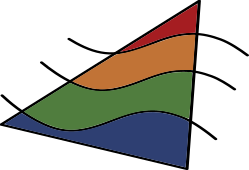


The Constrained Spectral Approximation (CSA) method is a physically sound and robust method for approximating the spectrum of subgrid-scale orography. It operates under the following constraints:
- Utilises a limited number of spectral modes (no more than 100)
- Significantly reduces the complexity of physical terrain by over 500 times
- Maintains the integrity of physical information to a large extent
- Compatible with unstructured geodesic grids
- Inherently scale-aware
This method is primarily used to represent terrain for weather forecasting purposes, but it also shows promise for broader data analysis applications.
See requirements.txt
NOTE: The Sphinx dependencies can be found in
docs/source/conf.py.
Fork this repository and clone your remote fork, then pip install -e ..
Run parameters are assembled programmatically inside the run scripts using the pycsa.config.params dataclass. Example experiment scripts live in runs/ and examples/; the reusable building blocks are in the pycsa package (pycsa.core, pycsa.wrappers, pycsa.plotting, pycsa.data, pycsa.compute).
Runs that read on-disk data (e.g. the global ICON+ETOPO pipeline) locate it through SPEC_APPX_* environment variables, which are read by pycsa/local_paths.py (copied from local_paths.py.template):
export SPEC_APPX_DATA_DIR=/path/to/data          # directory containing the ICON grid
export SPEC_APPX_ETOPO_DIR=/path/to/data/etopo_15s
export SPEC_APPX_MERIT_DIR=/path/to/MERIT        # MERIT runs only
export SPEC_APPX_REMA_DIR=/path/to/REMA          # MERIT runs only
export SPEC_APPX_OUTPUT_DIR=/path/to/outputs
Set these directly or with source setup_paths.sh. The bundled examples/ need no such setup — their data ships with the repo.
A simple setup can be found in runs/idealised_isosceles.py. After pip install -e . the easiest way to run it is via the console script:
pycsa-idealisedThe equivalent direct invocations also work:
python -m runs.idealised_isosceles
python3 ./runs/idealised_isosceles.py
However, the codebase is structured such that the user can easily assemble a run script to define their own experiments. Refer to the documentation for the available APIs.
Three self-contained examples ship with bundled data (no download needed):
- Idealised —
pycsa-idealised(synthetic terrain with a known spectrum; see the tutorial). - Aleutians / MERIT —
examples/icon_regional_minimal.py(real ICON cell, ~10 s). - Andes / ETOPO —
examples/icon_etopo_andes.py(real ETOPO cell with ocean-aware masking; see the showcase).
GNU GPL v3 (tentative)
Refer to the open issues that require attention.
Any changes, improvements, or bug fixes can be submitted to upstream via a pull request.