A small modern-C++ framework for bare-metal microcontrollers, built
around a cooperative active-object kernel: event queues, flat state
machines, time events, one loop, one stack, no heap, no virtual
functions, nothing resolved at run time that the compiler could resolve
first. Written in C++23 (gnu++23), header-only, in one flat namespace
brio ("con brio" - the musical marking for liveliness).
The kernel knows nothing about the silicon it runs on. Today it runs on AVR DA/DB (an AVR128DB48 on the bench), on SAM C21 (Cortex-M0+, an ATSAMC21J18A) and on STM32G0 (Cortex-M0+ from the other vendor, an STM32G0B1RE on a Nucleo-64) - the second and the third architecture each compiled the kernel and its services unchanged, which was the design's promise.
using P = brio::AvrPlatform;             // the one place the target is named

struct Toggle {};                        // events are small plain structs
struct SetPeriod { uint16_t ticks; };

struct Blinker : brio::Fsm<Blinker, Toggle, SetPeriod> {
    static inline brio::EventQueue<Event, 4, P> queue;                 // its own queue
    static inline brio::TimeEvent<P, Blinker, Toggle> heartbeat{Toggle{}};

    static void init() { Led::output(); start(&running); }

    static Status running(const Event& e) {
        return brio::match(e,
            [](brio::Entry) { heartbeat.arm_every(brio::ticks_from_ms<P>(500));
                              return handled(); },
            [](Toggle)      { Led::toggle(); return handled(); },
            [](SetPeriod p) { heartbeat.arm_every(p.ticks); return handled(); },
            [](auto)        { return unhandled(); });
    }
};

int main() {
    /* clock, timebase, sei() - target glue */
    brio::Kernel<P, Blinker, Supervisor>::run();   // priority = pack order
}
Somewhere else, brio::post<Blinker>(SetPeriod{...}) changes the
cadence - from another active object, from a time event, or from an
ISR: same call, always safe, never blocking.
- Active objects, run-to-completion. An AO owns a queue and reacts to one event at a time; it never blocks, waits or polls. The kernel serves the highest-priority non-empty queue, one event per turn, and sleeps when nothing is pending. The only concurrency is ISR vs main loop, and an ISR may do exactly one kernel thing: post an event.
- Everything is a type, resolved at compile time. AOs, drivers and the kernel are monostate classes selected by type; priorities, subscriptions and reply channels are template parameters. No tables walked at run time; RAM is exactly what is declared.
- Contracts are concepts. What the kernel needs from an AO
(
ActiveObject), from the machine (Platform), what a text sink must offer (ByteSink) - stated as C++20 concepts, checked where a type is used, with errors that name the requirement. - Events are values, per-AO variants. Each AO declares its own
std::variantof small trivially-copyable structs; events are copied into queues (a few bytes, one brief critical section). Plain shared structs are the lingua franca between publisher and subscriber; no global signal enum. Handlers dispatch withmatch(e, lambdas...). - Timers post events; failures leave a breadcrumb. A time event
posts to its owner AO in main context (never runs user code in an
ISR); a full queue is a sizing mistake counted, never blocking;
panic()writes a reset-surviving record before any LED blinks.
The full rationale, decision by decision, is in docs/design/ - start with overview.md and kernel.md.

open the diagram full size (zoomable in the browser)
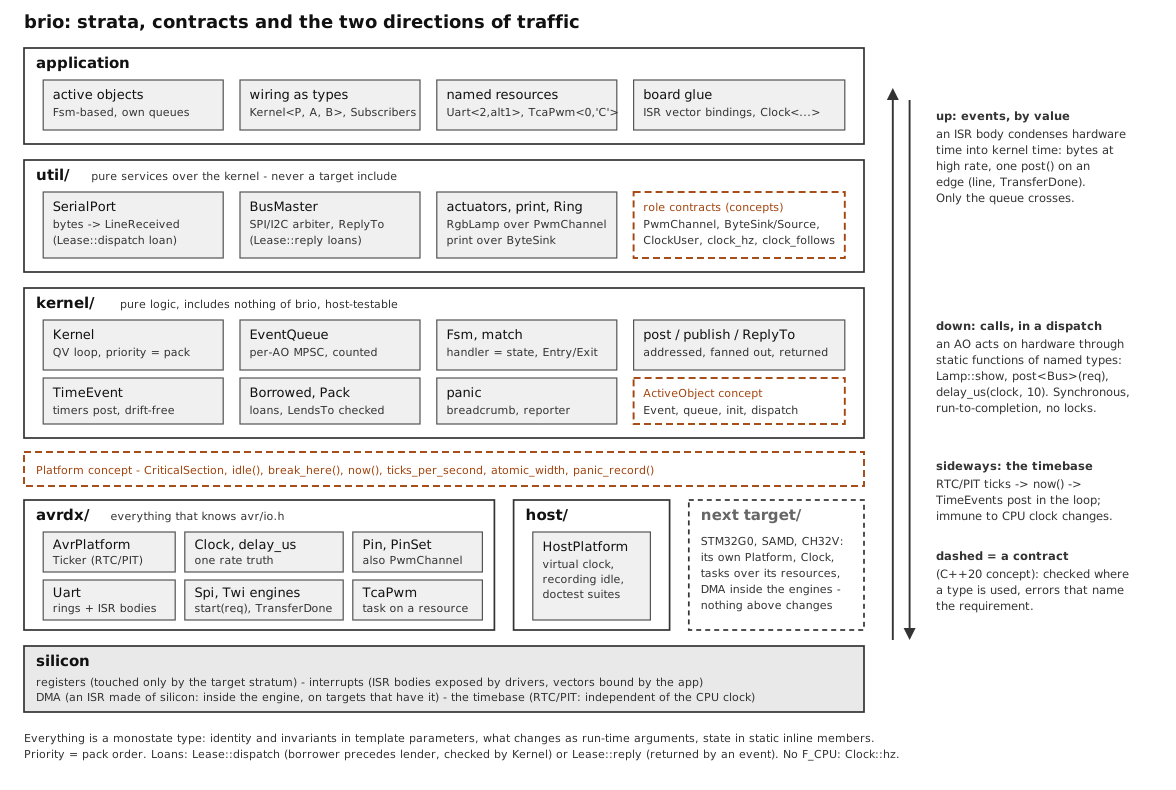
brio/ has four strata; the include prefix makes a file's
portability readable at a glance:
| Stratum | Contains | Depends on |
|---|---|---|
kernel/ |
queues, scheduler, FSM, delivery, time events, panic - pure logic | nothing of brio |
util/ |
services on top of the kernel: SerialPort, BusMaster (SPI/I2C arbiter), print, Ring, line parsers |
kernel/ |
avrdx/ |
everything that knows avr/io.h: clock, pins, UART, SPI, TWI, ticker, AvrPlatform |
kernel/, util/ |
armv6m/ |
what ARM designed into every Cortex-M0/M0+ and both ARM families share: NVIC + PRIMASK guard, the SysTick ticker | util/ (and the including family's device header) |
samc/ |
everything that knows sam.h (Cortex-M0+): clock tree, pins, SERCOM UART, SamPlatform; its NVIC and ticker are armv6m/'s |
kernel/, util/, armv6m/ |
stm32g0/ |
everything that knows stm32g0xx.h (Cortex-M0+): RCC/PLL, GPIO, USART, Stm32Platform; its NVIC and ticker are armv6m/'s |
kernel/, util/, armv6m/ |
host/ |
HostPlatform: the native test "target" (virtual clock, recording idle/break) |
kernel/ |
Targets are siblings, never meet in one binary, and are the only place
where hardware headers, ISR vector names and tick rates live. Nothing
above them uses #ifdef to tell targets apart: where behaviour must
differ, the target states a fact (ticks_per_second, atomic_width)
and generic code chooses with if constexpr or a concept.
| Target | State | Notes |
|---|---|---|
AVR DA/DB (avrdx/) |
on the bench | AVR128DB48, avr-gcc 16.2, see docs/avrdx/README.md |
SAM C21 (samc/) |
on the bench | ATSAMC21J18A, arm-none-eabi-gcc 16.2, SysTick tick at 1000 Hz (vs the AVR's 1024: the kernel tick's opacity, exercised for real), see docs/samc/README.md |
STM32G0 (stm32g0/) |
on the bench, bring-up | STM32G0B1RE (Nucleo-G0B1RE), arm-none-eabi-gcc 16.2, HSI16 x PLL at 64 MHz, the third clock model (shared bus prescalers + per-peripheral enables), see docs/stm32g0/README.md |
host (host/) |
in use | doctest suites, cd test && ctest --preset host, see docs/host/README.md |
The framework in brio/ is header-only, included directly. The
builds are four sibling CMake projects, one per toolchain, all peers
(the repo root is not a CMake project): avrdx/, samc/ and
stm32g0/ each auto-discover one main() per src/apps/<app>.cpp at configure time
- an app may pin build options such as its console baud with
// build: monitor_speed = 115200header lines - andtest/holds the host unit tests (a configure has exactly one compiler).
(cd test  && ctest --preset host)                                       # host tests: kernel, queues, FSM, time events, buses, ring...
(cd avrdx && cmake --build --preset avr128db48-release --target <app>)  # build one AVR app (release, -Os)
(cd avrdx && cmake --build --preset avr128db48-release --target <app>-upload)   # flash it over UPDI
(cd samc  && cmake --build --preset samc21j-release --target <app>)     # build one SAM app
(cd samc  && cmake --build --preset samc21j-release --target <app>-upload)      # flash it over SWD
(cd stm32g0 && cmake --build --preset stm32g0b1re-release --target <app>)  # build one STM32G0 app
(cd stm32g0 && cmake --build --preset stm32g0b1re-release --target <app>-upload)   # flash it over the ST-LINK
Everything target-specific - toolchain, board, probe, debugger, its quirks - is documented per target in each target's folder under docs/. The apps are the framework's test bench: disposable by design, they document themselves in their own header comment, and their current wiring lives in docs/bench.md.
Bench-tested on the AVR128DB48: kernel loop, time events, serial
console over SerialPort, arbitrated SPI (display + touch on one bus)
and I2C (DAC written and read back, ADC measured through SPI).
Bench-tested on the ATSAMC21J18A: the same kernel and the same
services, recompiled untouched - blink under time events and a full
serial console at 115200, byte-exact on the wire. Bench-tested on the
STM32G0B1RE: the same two apps, recompiled untouched again, on the
third clock model and the third crt. Under continuous,
deliberately radical revision: nothing below the kernel contract is
considered done (see the governing rule in
overview.md). Clean-room with respect to
QP: the concepts come from Samek's book, never the QP source.